Press
Twenty years of people writing things down. Some of it went well. The interesting parts are usually the ones that did not.
Voice technology
- VIDEO
Vijetha
My first television interview, in Telugu, at twenty-eight.
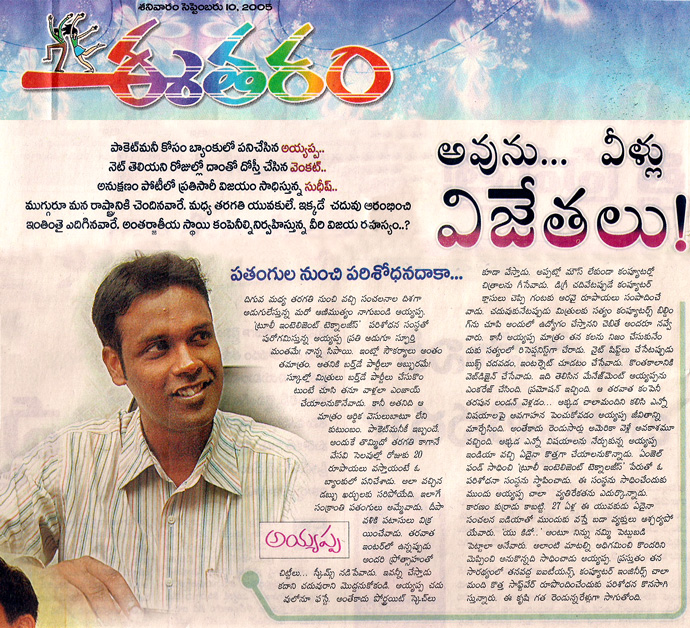
Eetaram
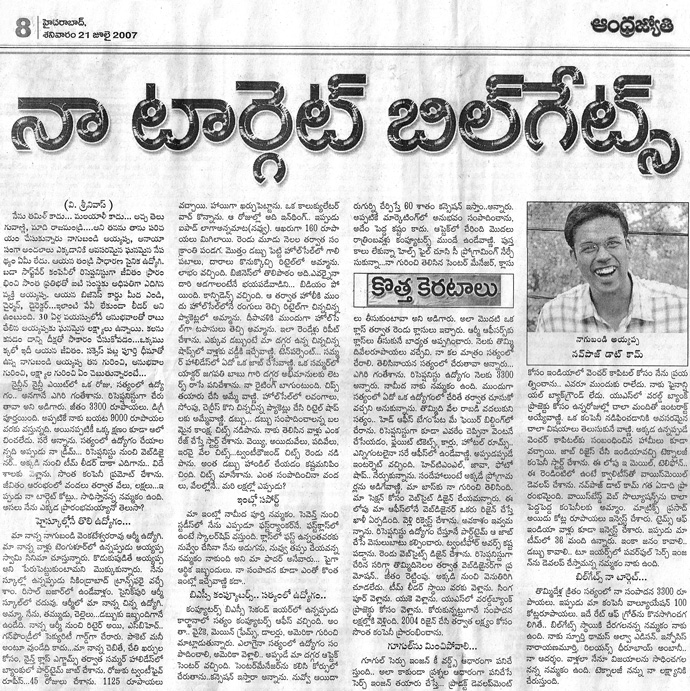
Telugu coverage two months before vMail launched. I have the cutting; the paper has no archive of it online.
World's 1st voice e-mail from India
The week vMail launched. You could send an email in your own voice, with no download and no plug-in, and the person receiving it did not need an account.
'Now Possible' is voice e-mail
Before this, investors could not trust a man who looked like he had just left college. After it, the first investor we met shut the door behind us and would not let us leave until we had a deal.
NowPos wins top 20 position for vMail
Frost & Sullivan named vMail among the top 20 broadband innovations in Asia Pacific. It was the first time an Indian company had appeared on that list. The service had been launched by the chief minister and had passed ten thousand users.
BCCL acquires stake in H'bad voice tech co
Brand Capital, the Times of India Group's investment arm, came in at a hundred crore valuation.
- VIDEO
From ideas to execution
One of the youngest founders to appear on the programme, and the first first-time entrepreneur on it.
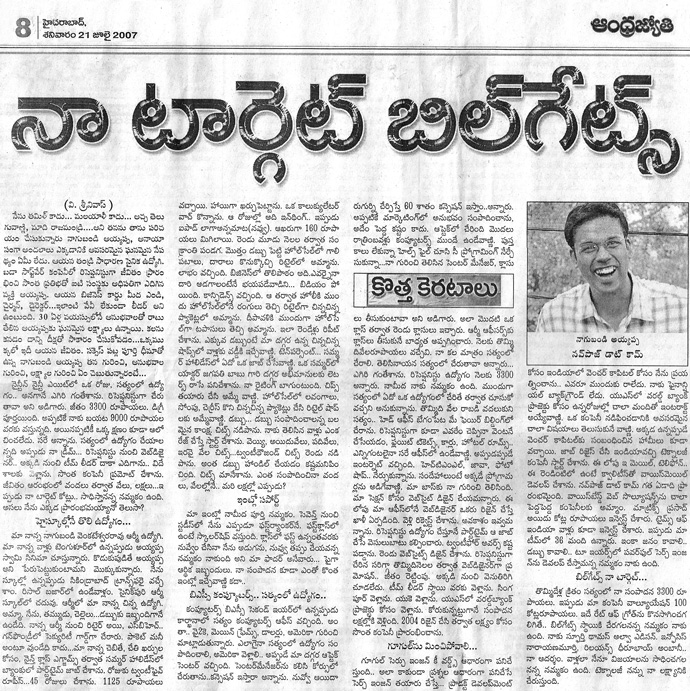
Newspaper feature
Telugu coverage from the NowPos years. Scanned from the cutting.
Now, ads directly on mobile screens
Newspaper feature
Scanned from the cutting. Only a small copy of the scan survives.
Hardware
An Indian company is making the world's first touch-enabled t-shirt
Broadcast Wearables. A t-shirt you could program, and then one you could touch.
- VIDEO
OMG! Yeh Mera India
National television, for a t-shirt.
Like instant coffee, instant idli is also possible now
The world's first automated idli machine, built with my wife Mahalakshmi.
Fancy some idli-sambar from a vending machine?
Installed in the Hyderabad Metro. The lockdown closed it a few months later.
Since
When India had its AI moment: a story from 2005
Written after DeepSeek, about what we built twenty years earlier and why it stopped.